Trying everything to arrive here, now.

A pictorial history:-
Purité Audio's twentieth anniversary this year, sadly my plan for world Hi-FI retail domination have not come to fruition but:-
It has been an interesting journey and allowed me to hear almost every interesting loudspeaker available.
I like Hi-FI, I like music too of course but I probably like the equipment at least as much.
First proper system were Meridian's gorgeous active M2 loudspeakers, then their not quite so gorgeous M10's. I kept the M10's for years until I made the mistake of leafing through an audio magazine at W.H. Smith.
B&W had just released their first 'Nautilus' design, 802 and 800's arrived they were really a difficult load, because I had no technical knowledge whatsoever and because I had always used active speakers I tried four or five power amps before I found something that could cope with their low impedance.
The Hi-FI retailers I asked for advice were to say the least either wilfully or knowingly unhelpful.
The forum I frequented suggested that horns were the ultimate Hi-FI expression and this led directly to starting Purité Audio, the horns I wanted were expensive the newly created manufacturer didn't have a UK representative...
I tried several pairs ending up with a hugely expensive four-way system, the 'Liszt'.

Cessaro 'Liszt' four way, Benchmark AHB2 amplifiers and Weiss convertor.
The 'Liszt' had active bass ad for the first time real extension, which was great but hugely excited the room.
I tried everything in terms of passive absorption, the typical 2" foam obviously now was completely useless. PSI's newly released AVAA impedance traps really worked but you need a lot of them.
RPG's 'Modex' membrane traps you can see three of them behind the horns are also effective but again you need the square footage.
I met Christoph Faller (Illusonic) at Munich he was demonstrating a stereo to tri-speaker system which was hugely convincing, his Illusonic processors introduced me to EQ, for the first time I could enjoy full-range sound without 'BOOM'!
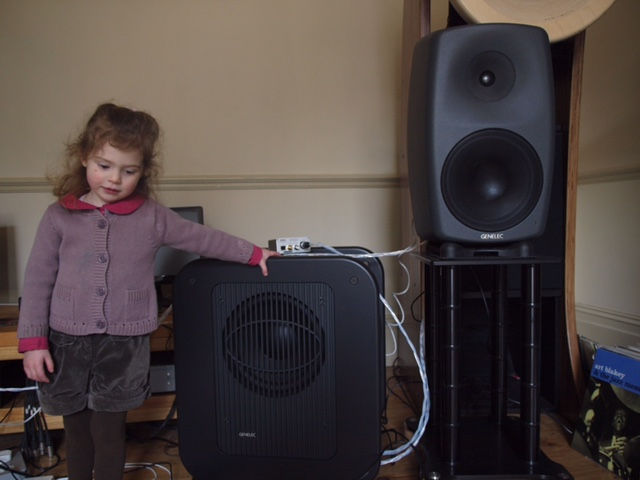
Around the same time Genelec introduced their first 'digital' speaker the 8260 and the first generation of their GLM software.
It was so cool, you connected up ( ugly ) subwoofers and the system instantly integrated them.
The Genelcs just made the horns sound 'wrong' they were clearer, went deeper, more dynamic with pin point imaging they spelt the end of my horn period.
I started to explore measurement led speakers that were actually deigned by proper engineers rather than 'gurus'.
Grimm LS1, Bruno Putzeys first loudspeaker design, followed quickly by his second the Kii THREE.

Shortly after we started to represent KII and completely out of the blue a guy emailed me saying if you like Kii you should really look at this new Dutch company Dutch&Dutch.
D&D at that time were making the 8M model similar to the 8c but without the cardioid response.
The 8Cs just sounded clearer and I have subsequently pursued cardioid designs since.
Geithain MEG their cardioid response is centred around the low bass.
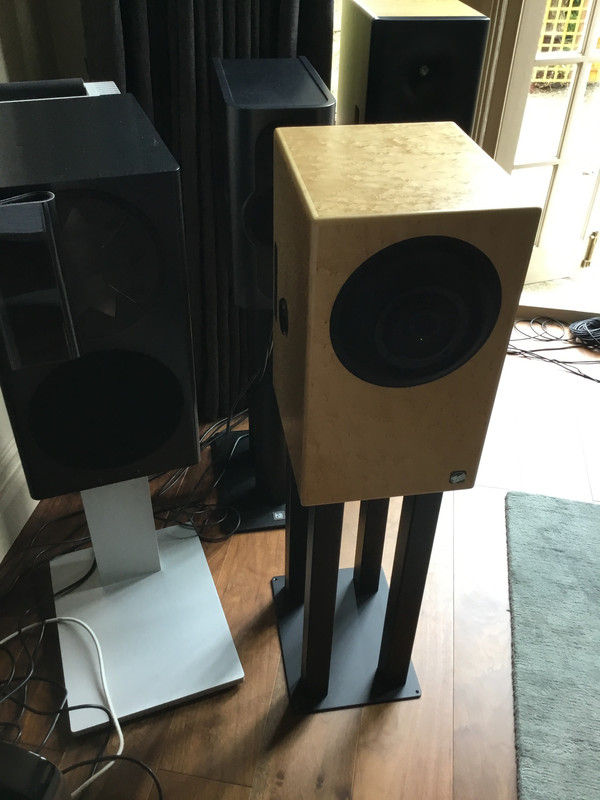
I looked at 'unusual' drivers, Manger's bending wave active C1 not a success.
Would sheer membrane area bring an improvement?
Hedd's 'Main Towers' which had a central main speaker which you can expand with sub-modules top and bottom.

Amongst the passive cardioids, Gradient were easily

the best and up to that point the best passive speakers I had heard, Gradient were well ahead of the curve as their designer Jussi told me they did everything that Kii are doing only better and cheaper!
I read of Deni Mesanovic's new RTM 10 which is a superb design, his ribbon tweeter married to 6.5" mid and 10" side mounted bass driver, Deni now also makes a cardioid design the CDM 65, which I must try at some point.

Mesanovic RTM 10, Hedd Mains in background.
Having Kii and D&D together garnered quite a bit of interest particularly from the 'pro' audio crowd.
Often I would hear, 'the Kiis are really good but you can't beat ATCs midrange'.
I approached ATC and they advised that their active 50's would be most suitable for my application.
The active 50's duly arrived in a gorgeous yew veneer, ( I always chose Yew for my Meridian M2s and M10s)

The comparisons were really interesting, engineers often madly switching between two or three level-matched set-ups.
I discovered that the myth of ATCs midrange is exactly that a myth, the 50's were solid enough speakers but compared to the contemporary designs D&D's 8C for example,
They were coloured, even though their enclosure was large bass extension was limited.
There was no adjustment whatsoever, I tried to optimise their placement but was never really happy and they were far more expensive.
Quite rightly ATC kicked us off after a few years because of poor sales but on the plus side we did sell quite a number of Kiis and 8Cs, to customers who asked to compare.
One spectacular yet probably the ugliest speaker we have ever had were Tom Danley's 'Hyperion' now called the HRE, utilising Tom's multi-entry-horn design and two 15" sub woofers.
There are no limits at least none that I was prepared to find, clarity, dynamics unlimited headroom.

Recently Sigbergs' Mantas have impressed again cardioid, about to arrive imminently (literally next week) are Roland Schafer's GGNTKT M3, an active cardioid four way design, designed again without constraint, their M1 was hugely impressive so I have very high expectations for the M3.

Finally a new manufacturer from Seoul, Korea, AsciLab ( Acoustic Science Laboratory).
AsciLab I don't believe I have ever been so impressed with a speaker, their tonality and timber are just right.
I believe that is because they are the finest measuring loudspeakers you can buy.
In my experience the better the measurements the more transparent the sound.
For me measurement is king.
I first noticed them when Jinsung posted some measurements on ASR which were spectacular better than anthing else I had seen..
AsciLab had purchased a Klippel NFS which allowed them to examine and improve every aspect of loudspeaker design.
Their initial models were two-way compact designs based on highly regarded SB Acoustics drivers.
Subsequently they have created two designs based on Purifi's superb 'Ushindi' low-distortion drivers, the A6B and S6B which also utilises the new Purifi PTT tweeter and twin Purifi 8"passive radiators.
The S6B is the ultimate two-way design, first deliveries expected early 2026.
AsciLab have also designed an active cardioid design the C8C, which can be coupled to a dedicated sub-bass module the BX8C.
The measurements ( AsciLab publish every measurement for every loudspeaker ) of the C8C are simply better in every metric than any other active cardioid currently available.
The C8C can be used on its own or you can choose in time to add the BX8C, AsciLab have just announced that it will have three presets, cardioid down to 35Hz/ 50Hz or full bass output.
This means that the C8C/BX8C can be placed in any room, in any position and still produce great sound.
Best of all the C8C will retail in the UK for £5000 per pair inc vat and delivery, ( £4500 per pair if you order before the 9th of January ).
The BX8C sub-module will retail for £5000 per pair for the pre-order period rising to £5500 per pair after January the 9th again including vat and delivery.
In comparison Kii's THREE/BXT combination retail for over £27.6k in 'standard matt white/matt grey) rising to £30750 in a 'premium' colour.
AsciLab are revolutionising

the loudspeaker landscape.

AsciLab C8C/BX8C active cardioid, the future of loudspeakers.


Comments